Victorian terraces are the backbone of Blackpool's residential property market. Walk down almost any street in the town and you'll find rows of them — bay-fronted, red brick, often built between 1880 and 1910 to house the workers who serviced Blackpool's booming tourism industry. They're characterful, often well-proportioned, and — when properly maintained — make excellent family homes. But they come with their own very particular set of surveying challenges.
I've surveyed hundreds of Victorian terraces in Blackpool, Bispham, Layton, and the surrounding areas over the years. In this article, I want to give buyers a genuinely useful account of what to expect — both from the survey process itself and from the typical issues we find.
Why Victorian Terraces in Blackpool Need a Level 3 Survey
I'll say this directly: if you're buying a pre-1920 Victorian terrace in Blackpool, please get a Level 3 building survey. I know it costs more. I know a Level 2 homebuyer report seems like a perfectly adequate option. But Victorian terraces have characteristics that genuinely warrant the deeper investigation a Level 3 provides.
These properties have solid single-skin external walls — no cavity wall insulation, no clear drainage layer. They have original roof structures — typically cut timber rafters — that may be 120+ years old. Many have had extensions, conversions, or alterations over the decades. The original drainage systems are often either partially replaced or still entirely original. A Level 2 survey is a visual check; a Level 3 is an investigation. For Victorian terraces, you need an investigation.
The Most Common Issues We Find
1. Damp — Penetrating and Rising
This is the big one. Damp is the single most common issue we find in Blackpool Victorian terraces. Penetrating damp — water entering through failed render, missing or cracked pointing, or deteriorating flashings — affects a significant proportion of older terraces. Rising damp, where groundwater is drawn up through the masonry, is also present in properties where the original damp-proof course has failed.
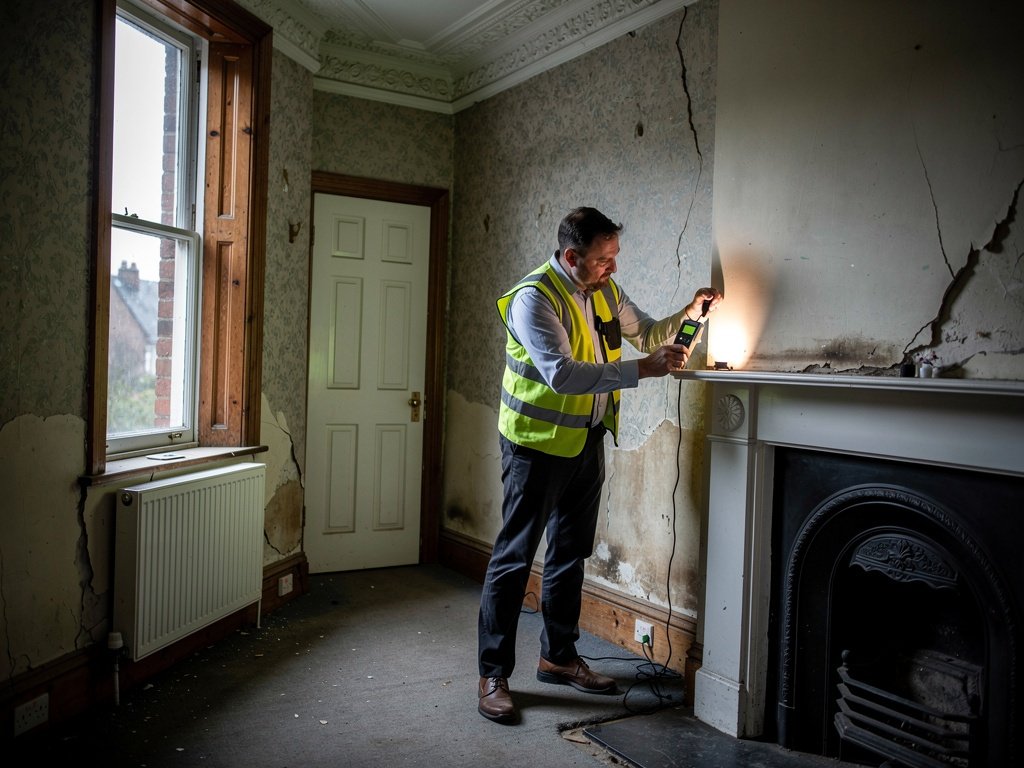
In some properties, fresh decoration has been used to mask damp. This is why our surveyors use calibrated moisture meters and probe suspicious areas — not just look at them.
2. Chimney Stack Problems
Victorian terraces in Blackpool almost universally have chimney stacks — and almost universally, those chimney stacks need at least some attention. The most common problems are: deteriorated pointing around the stack, cracked or spalled brickwork, and failed lead flashing at the junction with the roof slope. Any of these can allow water entry — which can affect not just the chimney area but the ceiling and walls below.
3. Roof Covering
Original Victorian slate or clay tile roofs have a typical lifespan of 80–100+ years, but only if well maintained. The majority of Victorian terraces in Blackpool are now of an age where the roof is either at or past the end of its original material's lifespan. We regularly find: slipped or missing tiles, deteriorating ridge tiles and mortar bedding, failed or absent lead flashings, and gutters that are cracked, blocked, or falling away from the fascia boards.
4. Timber Defects
Where there is a history of damp ingress — which there usually is in older Blackpool terraces — there is a risk of wet rot or dry rot in timber elements. This includes roof timbers, floor joists, skirting boards, and door and window frames. We carry out probing checks on timber where accessible and flag any areas of concern for specialist investigation.
5. Structural Movement
Some degree of historic movement is entirely normal in a 120-year-old building. The question a surveyor asks is: is this movement active (still happening) or historic (happened in the past and stabilised)? The answer usually lies in careful inspection of crack patterns, assessment of whether doors and windows still open and close freely, and a check of external brickwork for signs of ongoing movement. Most Victorian terraces in Blackpool show some degree of movement — significant active movement is much less common but does occur.
6. Single-Skin Wall Insulation
This isn't a defect as such, but it's worth flagging. Victorian terraces have solid external walls — typically a single leaf of brick. This means they have significantly worse thermal performance than modern cavity-wall properties. Many buyers don't factor in the ongoing heating costs associated with this. Where it's feasible to add insulation — either internally or externally — this is worth considering, but it needs careful specification to avoid creating new damp problems.
A Positive Note
Victorian terraces in Blackpool have survived 120+ years of coastal weather — they're fundamentally sound structures. The issues I've described are common, but they're manageable. The key is knowing what you're taking on before you exchange contracts. That's exactly what a good survey gives you.
What the Survey Process Looks Like
For a standard two-bedroom Victorian terrace, a Level 3 building survey inspection typically takes 2.5–4 hours on site. Our surveyor will work through the property systematically — exterior first, then interior — using a combination of visual inspection, moisture meter readings, probing of suspicious timber, and photography of all significant findings.
You'll receive your written report within 5 working days. It will be detailed — Level 3 reports for Victorian terraces often run to 50+ pages — but it will be written in plain English, with photographs of key findings and clear condition ratings for every element.
Buying a Victorian Terrace in Blackpool?
Don't go in without proper survey protection. Get a free, fixed-fee quote from our expert Blackpool surveyors today.
Get a Free Quote