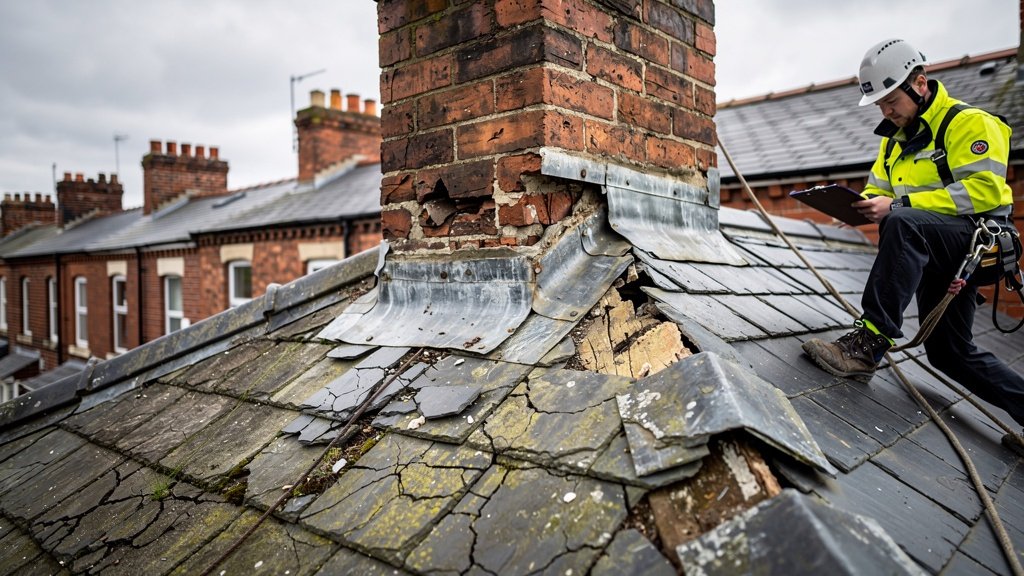
The roof is one of the most critical elements of any property — and in Blackpool's Victorian and Edwardian housing stock, it's also one of the most frequently problematic. Here are the five roof defects I find most commonly when carrying out building surveys across Blackpool and the Fylde Coast.
Problem 1: Deteriorating Chimney Stacks
If you're buying a Victorian or Edwardian property in Blackpool, the question isn't whether the chimney stack needs attention — it's how much. Chimney stacks on period properties have been exposed to coastal weather for over a century, and the problems tend to compound over time.
The most common chimney issues I find are: eroded pointing between brickwork (allowing water entry), cracked or spalled (flaking) brickwork, and failed lead flashing at the junction between the chimney and the roof slope. Any of these can allow water to track down into the property. The repair costs vary: repointing a chimney stack might cost £500–£1,200; if the stack needs rebuilding, costs can reach £3,000–£5,000+.
What to watch for during a viewing: Staining on the ceiling or walls near the chimney breast; white salt deposits (efflorescence) on the chimney breast internally; any visible cracks in the chimney stack from outside.
Problem 2: Failed or Aged Roof Tiles
The original clay or slate tiles on Victorian Blackpool properties have had a good run — but many are now 120+ years old, and some have simply reached the end of their effective lifespan. Common issues include: slipped tiles that have moved out of position, allowing water ingress; cracked tiles; deteriorating mortar on ridge tiles and hip tiles; and areas of the roof where tiles have been replaced piecemeal with mismatched materials.
A roof that needs significant tile work might cost £1,500–£4,000 to repair. A full re-roof is more significant — typically £5,000–£12,000+ for a standard Victorian terrace, depending on materials and the extent of any structural work needed alongside.
What to watch for: Any daylight visible in the roof void during a roof space inspection; staining on rafters or roof structure indicating water entry; tiles that look significantly different in colour or style to adjacent tiles (indicating previous patching).
Problem 3: Failed Flat Roof Extensions
The back-addition single-storey extension is almost universal on Victorian Blackpool terraces. These were added throughout the 20th century for additional kitchen or bathroom space. Many have flat felt roofs that have long since surpassed their intended lifespan of 15–20 years.
A failed flat roof on a rear extension typically shows as water staining on the ceiling below, or bubbling and cracking in the felt covering. The good news is that flat roof replacement is relatively straightforward — a quality modern system (GRP or EPDM rubber) on a standard extension might cost £1,500–£3,000. The bad news is that if it's been leaking for a while, the damage to the ceiling, walls, and any timber below can significantly add to the remediation costs.
Problem 4: Blocked or Deteriorating Gutters and Downpipes
This might seem like a minor issue compared to structural roof problems, but blocked gutters and downpipes are consistently one of the biggest contributors to damp problems in Blackpool properties. When gutters overflow, water runs down external walls rather than being directed away from the building. Over time, this penetrating damp damages pointing, render, and — in solid-walled Victorian properties — eventually penetrates to the interior.
Guttering repair and replacement is not expensive in itself — a full guttering replacement might cost £600–£1,500. But the damage caused by years of overflowing gutters can be significantly more costly to address. I always inspect gutters carefully, and I flag blocked or deteriorating gutters in even relatively minor reports.
Problem 5: Deteriorating Felt and Lead Valleys
Where two roof slopes meet — in a valley — there's typically a lead or felt lining to channel water away. On Victorian Blackpool terraces, the original lead may be 50–100 years old, and the bitumen felt used in mid-20th century repairs may be 30–40 years old. Both deteriorate over time, and failed valley linings are a very common cause of localised but persistent water ingress into the roof space.
Valley repair costs depend on materials and extent — from around £500 for a small felt repair to £1,500–£3,000+ for a full lead valley replacement. If the valley has been leaking for some time, associated timber rot may need addressing separately.
The Coastal Factor
All five of these issues are more prevalent and tend to deteriorate faster in coastal Blackpool properties. Salt air accelerates the degradation of mortar, lead, and felt. Properties within 500 metres of the Irish Sea should be inspected with particular care.
Worried About a Roof on a Blackpool Property?
Book a Level 3 building survey with Blackpool Surveyors. We'll give you a clear picture of the roof's condition and estimated repair costs.
Book a Survey